5 Ways Pure Sound Frequencies Quiet the Hidden "Alarm" Behind Restless Nights, Nagging Aches and Brain Fog
(And Why Pills, Supplements and Sleep Apps Keep Missing It)

By Rachel Combs, Contributing Writer
Updated October 19, 2026 · 6 min read
Summary: Wired at night. Worn out by noon. Tense for no clear reason. Foggy by 3 p.m.
These may not be four separate problems. Often they're one: a nervous system that never gets the signal to stand down.
Below: what that hidden "alarm" is, why pills and apps keep missing it – and how a small frequency device gives your body a steady rhythm to settle into, 15 minutes a day.
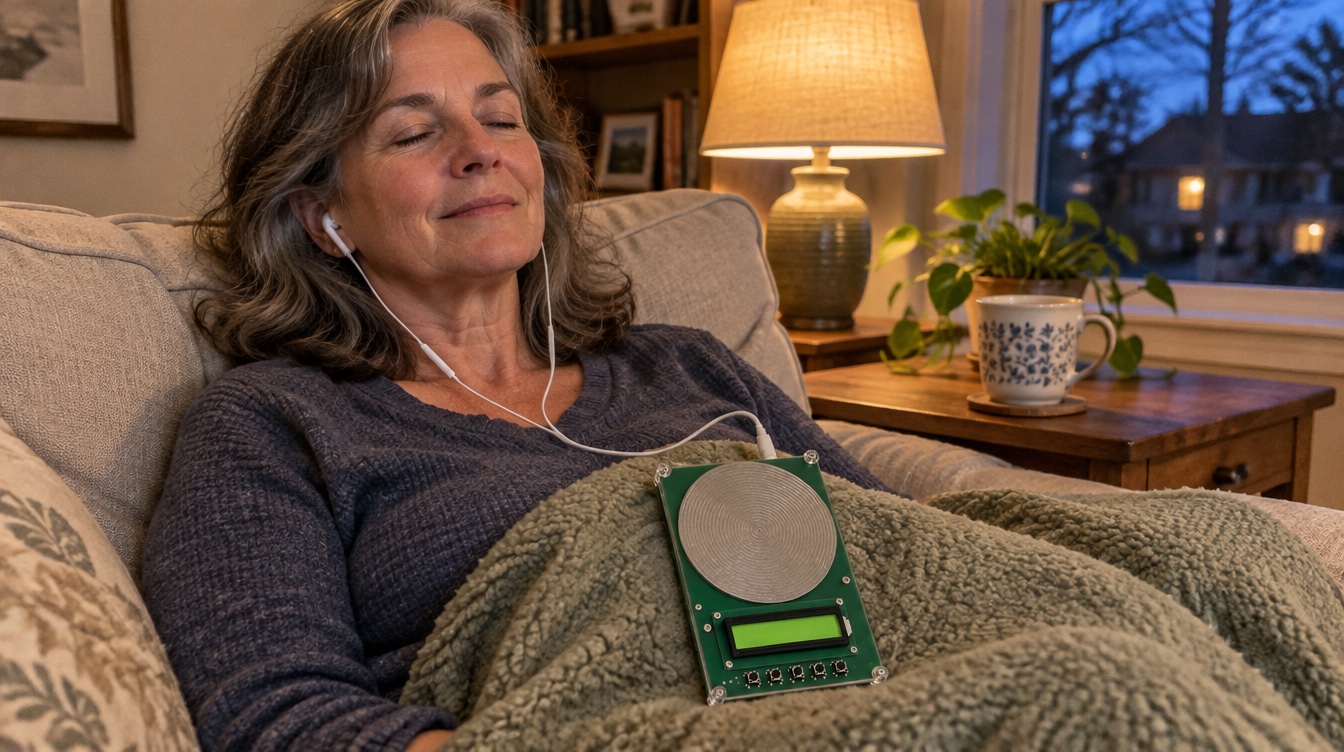
Think about the last time a sound changed how you felt – in seconds. Rain on the roof. The hum of the car on a long night drive. Waves rolling in, one after another.
You didn't decide to relax. Your body simply followed.
That isn't a coincidence, and it isn't "all in your head." It's one of the oldest principles in physics. And it may explain why, on so many evenings, you can't switch off no matter what you try.
You're far from alone. About 51.6 million American adults live with chronic pain, according to the CDC – and more than a third of adults regularly sleep less than the recommended seven hours. For many people over 50, it's both at once.
Here are five ways pure sound frequencies work with your body – and why the usual fixes keep falling short.
Your Body Falls Into Step With the Rhythm Around It
In 1665, the Dutch scientist Christiaan Huygens noticed something odd. Two pendulum clocks hanging side by side always ended up swinging in a locked rhythm with each other – no matter how he started them.
Scientists now call it entrainment: when two rhythms meet, they pull each other into step.
Your body does it all day long. Your footsteps match the beat in your ears. Your breathing slows with slow music. In a study published in the medical journal Heart, the rhythm of the music measurably pulled listeners' breathing and heart rhythms along with it – and in the quiet pauses, heart rate and blood pressure dropped below where they had started.
Your brain follows outside rhythms, too. A 2019 analysis of 22 studies found that steady beat frequencies played through headphones measurably reduced anxiety and changed how strongly people felt pain.
The RestWaves solution: Instead of fighting a racing mind, you give it something steady to follow – one clean, constant frequency – and let your body do what it has always done: fall into step.

A 1930s Inventor Bet Everything on Frequencies – Then His Work Disappeared
In the 1920s and '30s, a San Diego inventor named Royal Raymond Rife built some of the most powerful light microscopes of his day. Then he made a far bolder claim: that every living thing has its own resonant frequency – and that the right frequency could affect it, the way an opera singer's note can shatter a wine glass.
What happened next depends on who you ask. His supporters say the medical establishment buried his work. His critics say his big claims were never proven. Either way, Rife died in 1971, largely forgotten.
But the idea at the heart of it never went away – because the physics is real. Everything vibrates. Bridges, guitar strings, wine glasses: everything has a frequency it responds to most. Including the rhythms of your own body, as you just saw.
The RestWaves solution: RestWaves doesn't repeat Rife's big claims. It takes the part science can back up – that your body responds to steady rhythm – and puts it in your hand for a fraction of what "frequency machines" have traditionally cost.
Bonus: Unlike Rife's laboratory, it fits in your nightstand drawer.

The Hidden "Alarm" Behind Bad Sleep, Nagging Aches and Brain Fog
Here's what most people are never told: restless nights, tension that won't let go and that 3 p.m. fog are often not separate problems. Many times they share one root – a nervous system stuck in "alarm mode."
Your body runs on two settings. One is built for danger: heart up, muscles braced, mind scanning for trouble. The other is built for rest and repair. Stress, pain and too many short nights can leave the alarm switched on long after the danger is gone.
And the alarm feeds itself. Researchers at UC Berkeley found that after a night without sleep, the brain's pain-sensing regions fired harder while the regions that normally dampen pain went quiet – people felt pain at lower temperatures than before. Pain keeps you up. Lost sleep turns the pain up. Round and round it goes.
Does any of this sound familiar?
- You're exhausted at 8 p.m. – and wide awake at 11.
- Your shoulders live somewhere up near your ears.
- You wake at 3 a.m. and your mind is already running.
- By mid-afternoon you read the same sentence three times.
- Your doctor says your labs look "fine."
The RestWaves solution: Instead of chasing one symptom at a time, RestWaves goes after what they share – giving your nervous system a slow, steady rhythm that tells it the danger has passed.

Why Pills, Supplements and Sleep Apps Keep Missing It
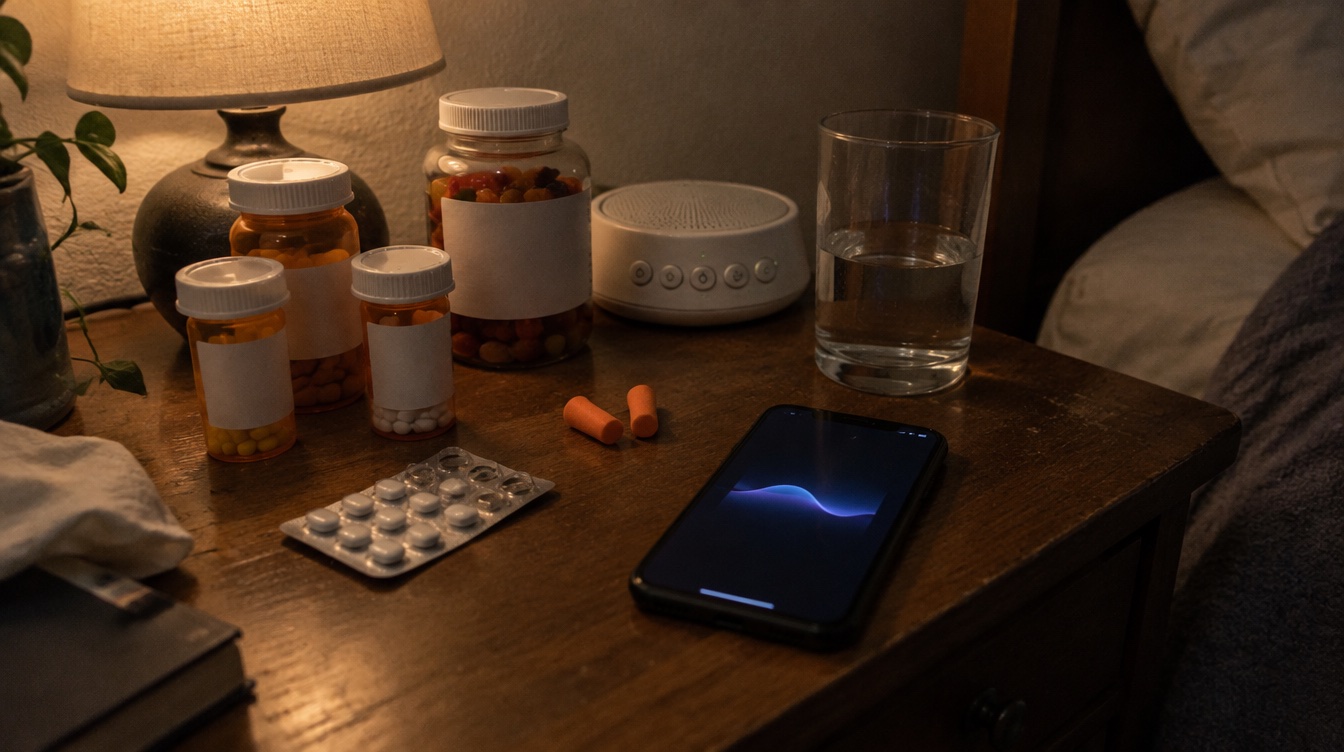
If you've tried to fix this, you're in good company. Most of us have a nightstand that tells the story.
- Sleeping pills can knock you out – but they don't teach your body to calm down, and many people wake up groggy and uneasy about needing them every night.
- Pain relievers take the edge off for a few hours. Then the tension creeps back.
- Melatonin, magnesium, teas and gummies help some people a little. Most end up half-full in the cabinet.
- Sleep apps and "relaxing sounds" put your phone in bed with you – along with the bright screen, the notifications and compressed audio squeezed out of a tiny speaker. And most of them want a subscription.
The common thread: each one works on a single symptom. None gives your nervous system a steady signal to settle into.
The RestWaves solution: One clean frequency from a dedicated generator. No phone. No screen. No app. No pills.
Bonus: That drawer of half-finished bottles can finally be cleared out.
The Frequencies Sound Healers Have Trusted for Decades
Sound healers don't pick their frequencies at random. Over the decades, a handful of numbers have become the backbone of their practice:
174 Hz
Used to release tension and help the body let go.
396 Hz
Used to quiet worry and the endless mental to-do list.
528 Hz
The best known of all – used for calm and balance.
7.83 Hz
The "Schumann resonance," the Earth's own natural electromagnetic rhythm – used for grounding and sleep.
Is there science behind it? Some – and it's growing. In a small 2018 study at Juntendo University in Japan, listening to music tuned to 528 Hz lowered levels of the stress hormone cortisol, while the same music at standard tuning didn't. Only nine people took part, so it's an early result – but exactly the kind that has researchers paying attention.
The RestWaves solution: RestWaves lets you set any of these frequencies on its small display in a few button presses – and plays it as a pure tone, not buried inside a music track.
So What Now?
If your body has been stuck in alarm mode for months or years, you really have four options:
- Keep collecting pills and supplements – each aimed at one symptom, none at the alarm itself.
- Book private sound-healing sessions – a single one-on-one session can easily cost $100, and you can't book one at 11:48 p.m.
- Buy a professional "frequency machine" – they have long sold for hundreds or even thousands of dollars, and most are built for practitioners, not your living room.
- Or give your body a steady rhythm at home – every evening, for 15 minutes, for a one-time price.
That last option is why we took a closer look at RestWaves.
Pills, Apps & Sound Sessions vs. RestWaves
| Pills, apps & sessions | RestWaves | |
|---|---|---|
| Gives your body a steady rhythm to follow | ✗ | ✓ |
| No pills, no morning grogginess | ✗ | ✓ |
| No phone or screen in bed | ✗ | ✓ |
| One-time price, no subscription | ✗ | ✓ |
| 30-day money-back guarantee | ✗ | ✓ |
Introducing RestWaves: Pure Frequencies, Right in Your Hand
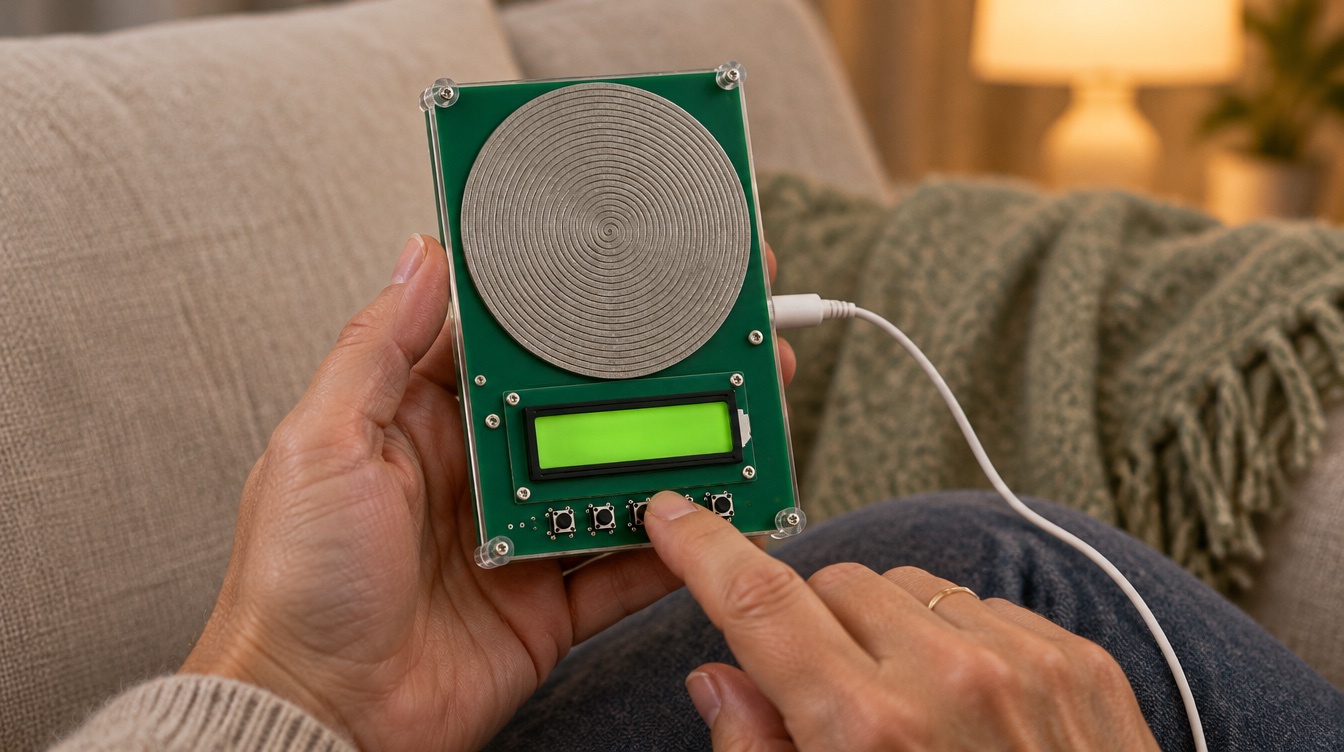
RestWaves is a compact frequency generator built on a single circuit board – a round spiral-coil plate on top, a small display and a row of buttons below. Choose a frequency, put in the earphones or rest the coil plate in your lap or beside your pillow, and give it 15 minutes.
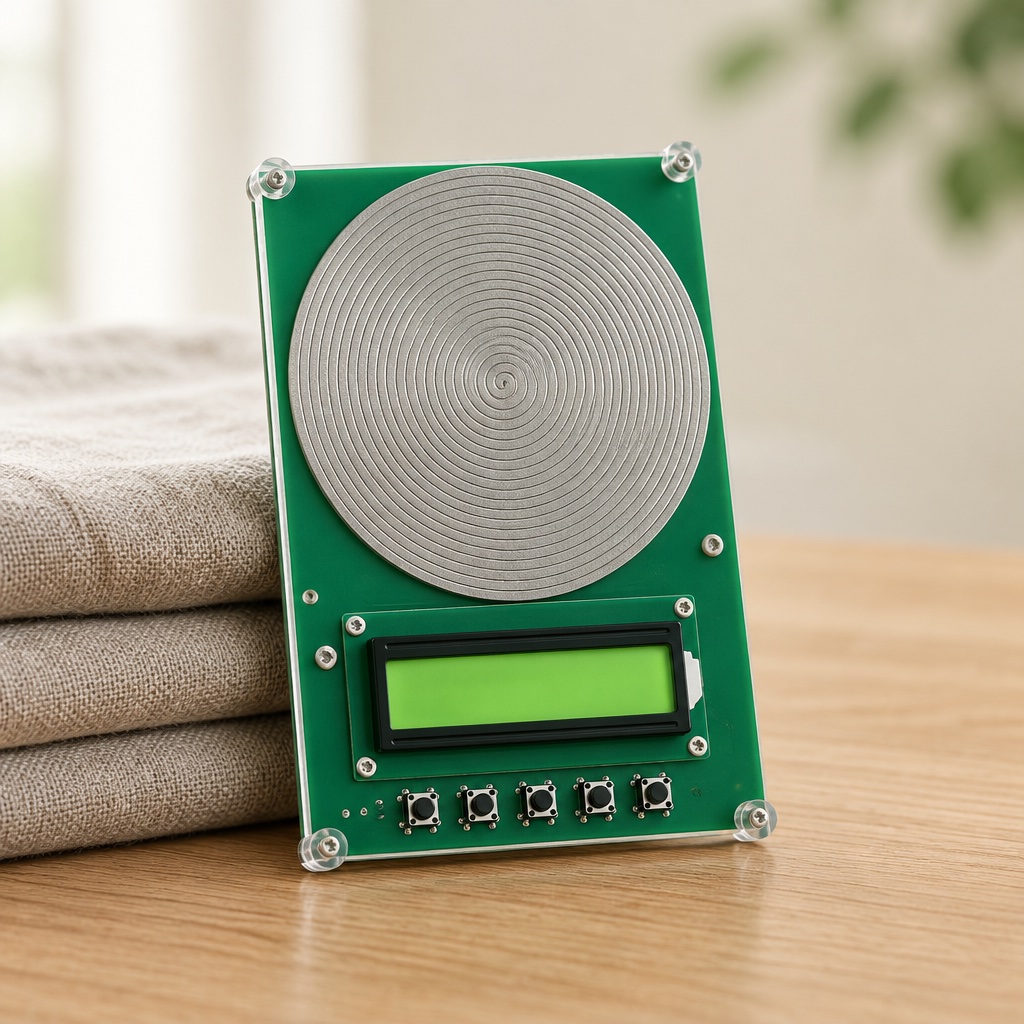
- Pure sine-wave tones from a dedicated generator – not a compressed music file
- Set 174, 396, 528 or 7.83 Hz in a few button presses
- Two ways to use it: earphones or the flat spiral-coil plate
- No app, no Wi-Fi, no subscription
- Runs on USB power – any phone charger or power bank works
- Complete kit: second coil pad, earphones, audio and USB cables, zip carrying case
- 30-day money-back guarantee
How RestWaves Works
Pick your frequency
Set 174, 396, 528 or 7.83 Hz on the small display. It takes a few seconds.
Earphones in – or plate in your lap
Listen through the earphones, or rest the flat coil plate in your lap or beside your pillow.
Give it 15 minutes
Sit back, breathe slowly and let your body follow the rhythm. Same time every evening works best.
READER OFFER
Try RestWaves Risk-Free for 30 Days
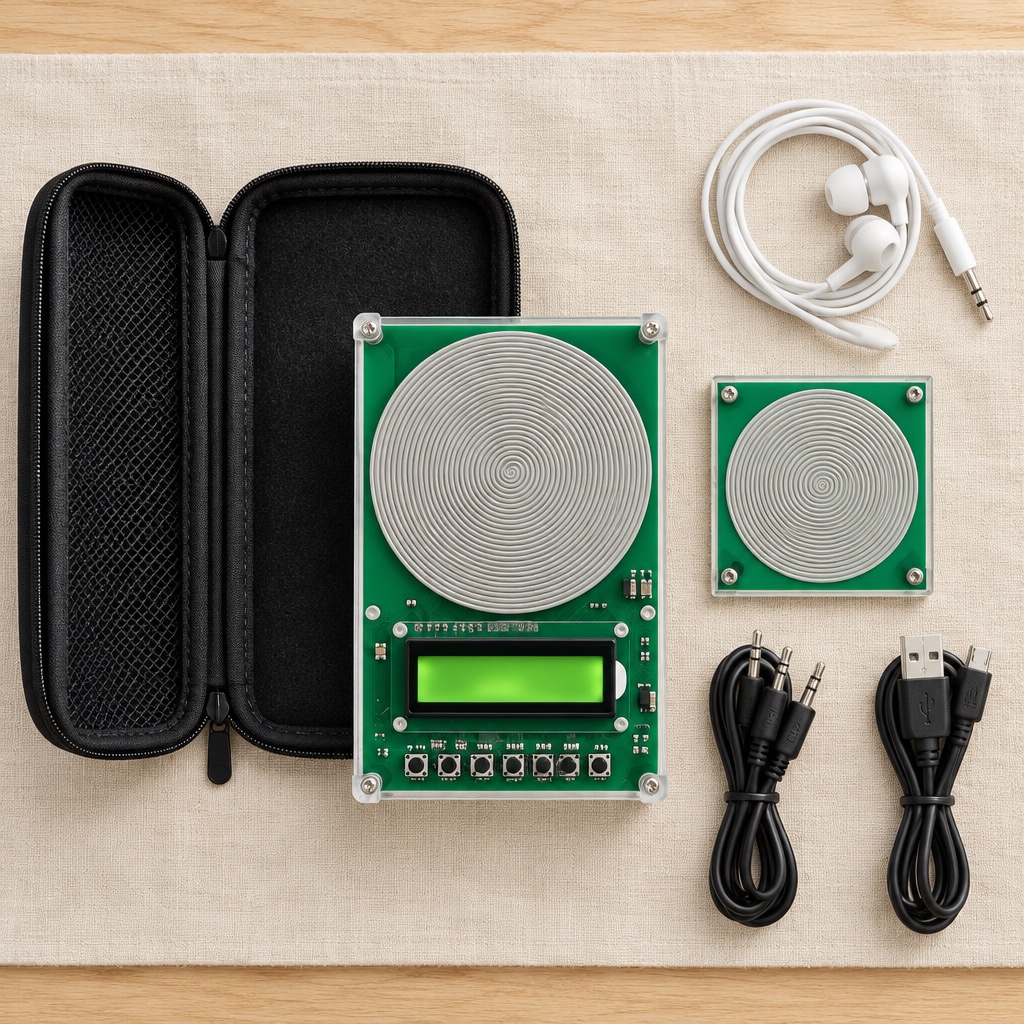
Complete kit: generator, coil pad, earphones, cables and carrying case
Limited stock – this batch sells out fast.
🔒 Secure checkout·↩︎ 30-day money-back guarantee·✉︎ Email support
Frequently Asked Questions
Tonight you can reach for the phone, the pill bottle or the remote again. Or you can give your body 15 quiet minutes – and something steady to follow.
Get RestWaves Now →Sources
- CDC, MMWR 2023: Chronic Pain Among Adults – United States, 2019–2021 – https://pmc.ncbi.nlm.nih.gov/articles/PMC10121254/
- CDC, MMWR 2016: Prevalence of Healthy Sleep Duration among Adults – United States, 2014 – https://www.cdc.gov/mmwr/volumes/65/wr/mm6506a1.htm
- Bernardi et al., Heart 2006: Cardiovascular and respiratory changes induced by music – https://pubmed.ncbi.nlm.nih.gov/16199412/
- Garcia-Argibay et al., Psychological Research 2019: Binaural beats, anxiety and pain perception – a meta-analysis – https://pubmed.ncbi.nlm.nih.gov/30073406/
- Krause et al., Journal of Neuroscience 2019: The Pain of Sleep Loss – https://pubmed.ncbi.nlm.nih.gov/30692228/
- Akimoto et al., Health 2018: Effect of 528 Hz Music on the Endocrine System and Autonomic Nervous System – https://www.scirp.org/html/2-8204397_87146.htm
- Huygens' synchronization experiment revisited (arXiv) – https://arxiv.org/abs/1805.05070
- Royal Raymond Rife – Wikipedia – https://en.wikipedia.org/wiki/Royal_Rife
- Schumann resonances – Wikipedia – https://en.wikipedia.org/wiki/Schumann_resonances
More from The Frequency Report
5 Hidden Benefits of Frequency Healing – Could This Be the Natural Answer Your Body Has Been Waiting For?
7 min read